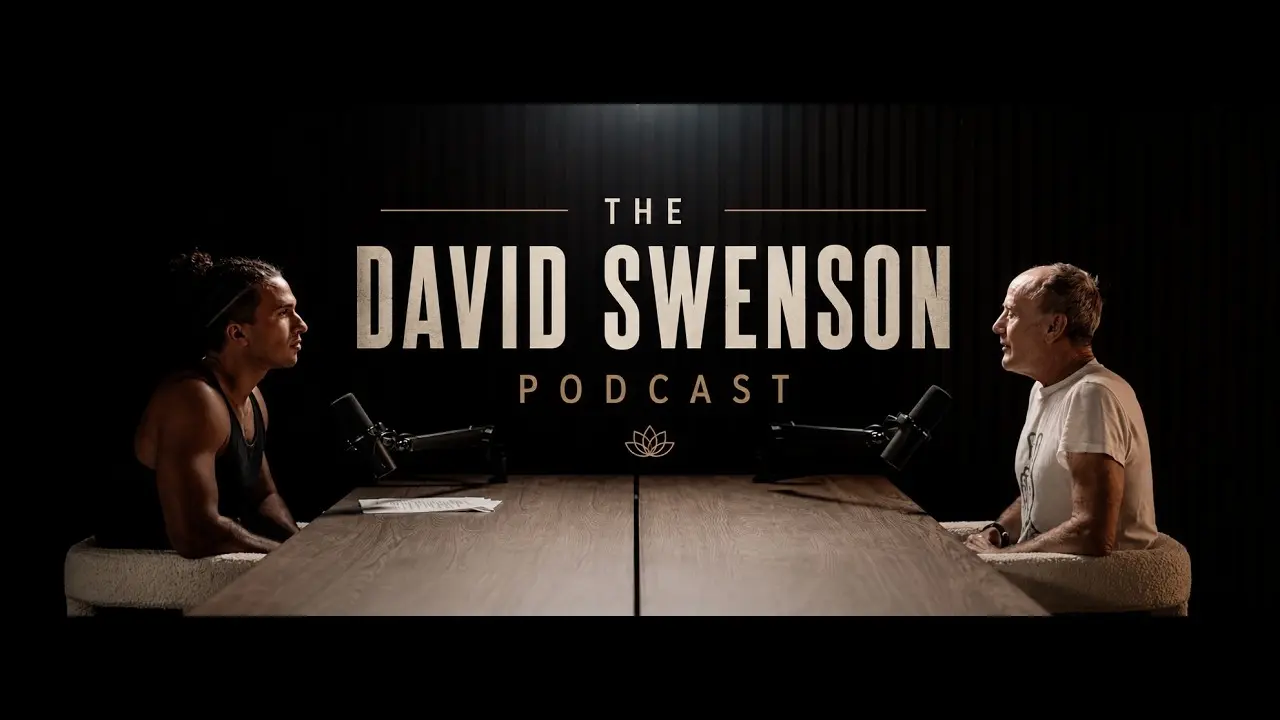
Some conversations feel like a transmission. In this one, Jonah sits across from David Swenson — one of the first westerners to learn the full Ashtanga system, practicing since 1969, and the author of the practice manual Jonah calls his Bible. Three generations of Kests have carried stories about David. This is the first time the two sit down together, in the flesh.
From a Texas park to a dirt-floor shala
David started yoga in Houston in 1969, at thirteen. No studios, no teachers, no mats — just a couple of books, a park, and an older brother who had heard about yoga through surfing. At sixteen he walked into an unheated room in Southern California and heard something he had never heard before: walls that seemed to breathe. The teacher was David Williams. By 1977, Williams and Nancy Gilgoff were leaving for Mysore, and Swenson took over their classes on Maui — a shala with eight walls, a clear plastic roof, and a dirt floor they rebuilt after every practice.
If you don’t need much, you don’t have to work as hard. The more stuff you want, the harder you’ve got to work. If you can learn to live simply, there’s some freedom in that.
The real yoga is what you cannot see
A friend of David’s has been blind from birth. She has completed his teacher training and can adjust students through the series — and she has never seen a yoga pose, a book, a mirror, or another student. So what is yoga for her? What’s left when everything visible is stripped away? That, David says, is the real yoga. It’s why he never stops a student who can’t bind: the practice isn’t named after your hands meeting. He watches for integrity instead — quality of breath, presence, focus.
Rather than focus on what someone cannot do, you figure out what they can — and build upon that.
An asana waiter, not a master
On adjustments, David is simple: good adjustment, good memory; bad adjustment, bad memory. He teaches a zero-to-ten rule for pressure, listens for breath and resistance, and tells every room that a student can always say no. Power belongs with the student.
In a Mysore class I never think of myself as the master in the room. I’m an asana waiter. I’m there to serve the needs of the student.
Darkness to light
The literal meaning of guru, David reminds Jonah, is darkness to light: someone in a cave extends their candle and lights yours. No contract, no conditions, no claim to be the only candle-lighter you’ll ever have. The knowledge is shared, and then it’s yours. The guru is the practice — not a person.
A good teacher creates thinking students. And the best of all teachers create students that don’t need them anymore.
A pranic force field
Why practice at all? David’s image is straight out of a space movie: life keeps firing missiles — the weather, the economy, everything we can’t control — and practice builds the force field. The problems still come, but they pass through a filtration system, and we respond differently. And when progress plateaus for years, that’s not failure: sometimes yoga isn’t about constant progress, it’s slowing the rusting phases of life.
Only dead fish go with the flow
David’s memoir is called Only Dead Fish Go With the Flow — a warning against drifting with whatever surrounds you. Growing up in Texas, doing yoga and eating vegetarian was not the flow. Sometimes you have to keep swimming. His parting advice to the next generation is as simple as it gets:
Don’t be frightened to try new things.
Watch the full conversation above.